Wednesday, December 7, 2022

Sunday, October 30, 2022

Jupiter family photo, Saturn


A couple of Jupiter images with Europa and Ganymede in front of the planet and Io on the right. Captured on 26 Oct 2022 from Ederi hill. 


Saturn captured on 26 Oct 2022, 17:53 UT from Ederi hill. 

Tuesday, May 26, 2020

Chromatic Venus


This trio of Venus images captured when the planet was close to the horizon on May 25, 2020, shows the effects of atmospheric chromatic dispersion. In the first image I had forgotten to put on the UV/IR blocking filter, and I believe the white-ish edge is from infrared light. The second and third images are from the same video capture, with the UV/IR filter on the camera. The difference is, for the second image I did not align the color channels, in order to represent the view seen by eye through the telescope. 

Saturday, April 7, 2018

Blade Runner 2049? No, Crete 2018


The most impressive Saharan dust event in more than a decade here on Crete happened on 22 Mar 2018. As the day progressed the sky went from yellow to deep orange. All photos are taken with daylight whitebalance, and no post-processing has been performed. 

Sunday, April 1, 2018

The Moon with my old digicam


OK, not a planet this time, but our beautiful Moon. It was the first time I tried the raw option for the Moon with my old Canon S80 digital camera (with the CHDK firmware update). The camera was handheld over the eyepiece. By lucky coincidence the camera's objective fits snugly into the 26 mm Meade eyepiece "barrel", so it is quite easy to hold the camera stable. Without the raw shooting mode I get lots of color fringing and softness at the edges of the Moon (from the eyepiece), but this can all be corrected during the raw "development". Not bad for a 12 year old camera. Shot from my terrace on Feb 8, 2017 (probably). 

Jupiter, May 2017


I am falling behind in my updates :-) This was captured almost a year ago; I think from the Ederi hilltop, on May 3rd 2017 (probably). 

Saturday, April 29, 2017

Jupiter and Io

Jupiter with Io disappearing behind the planet, and reappearing from the shadow later. Captured from Juchtas, Crete (~800 m altitude) on 28 April 2017. The "jump" in the animation is from when I relocated from a little below the peak, to the actual peak where the seeing was better. Even just slightly below the peak I could feel an intermittent cold drainage flow, and the telescopic views were blurred as a result.


Monday, May 12, 2014

Saturn at opposition (almost), and Mars

Saturn reached opposition on May 10th, 18:15 UTC. Unfortunately the weather was cloudy at that time. This image was taken the following evening, around 27 hours after opposition. Around opposition the rings brighten quite suddenly and quite a lot; this is because the rings are illuminated from directly behind the observer. This effect is often called the Seeliger effect


From the same evening, my only Mars image so far this year. Pretty unimpressive...


Thursday, March 27, 2014

Returning with Jupiter...

It's been quite a while since my previous post - almost two years. During this time I have only occasionally done some observing. The reasons are many; work, other interests (I have been very interested in calisthenics the last couple of years), being tired of mosquitoes getting into my flat every time I open the door to take out or take in the telescope, being plain old lazy, and simply not finding the same joy as before in astronomy. Nevertheless, I do not intend to let this blog share the fate with so many blogs that die after a few posts. So, for starters, here is an image of Jupiter from some time ago. Captured from Ederi hilltop on 19th March 2014,  1741 UT.


Wednesday, April 18, 2012

Mini-review of Glatter Parallizer

As a planet imager I am obsessed with accurate collimation. One of the many sources of error lies in the lose fit between a 1.25" adapter and the 2" focuser, and lose fit between the 1.25" collimator and the adapter. In the past I would solve this by shimming the adapter (with tape) and the barrel of my laser collimator, making the fit so tight that I had to put the shimmed 1.25" adapter in the freezer to be able to insert it in the 2" focuser tube! That also meant I could not remove the adapter in the field.

My recently aquired Glatter Parallizer has solved my problems. While I have not done any extensive testing, I can tell that it gives me about the same accuracy as I could achieve with my best shimming efforts. What remains of wobble is probably inherent in the focuser and laser collimator. The design is remarkably simple, just an angled setscrew and outer surface that isn't quite round. The "manual" is equally short; just one sentence!


Tuesday, April 17, 2012

Recent images

Just a couple of my better Mars images, and a Saturn...


Wednesday, April 4, 2012

New camera problem

My new DBK618 camera has a problem with gridlines at 60 fps. I posted about this over in the Imaging Source forum a couple of weeks ago, and they are (still) looking into the problem. One of the big selling points of this camera is its (supposed) 60 fps capability without artefacts. The model it surpasses, the DBK21, was also supposed to support 60 fps, but eventually it turned out that it produced a "ring"-artefact at this frame rate. It is therefore disappointing that once again this new model does not function properly at 60 fps. It is also surprising that nobody else have reported this problem before, as the camera has been on the market for more than 6 months. After I reported my problem at the forum, a couple of other owners of the camera have reported the same problem. Nevertheless, the results so far (at 30 fps) seem to be significantly better than my old DBK21. 

Below is Mars from a 60 fps capture (sharpened and resized by 2X). It does not matter which DeBayer method I use, the gridlines are always there. Multipoint alignment will partially solve/mask the problem, probably because different parts of the planet are moved around a little relative to each other, and blended in a way that hides seams and averages out some of the gridlines. Still, it is not a good solution. 


Monday, February 20, 2012

First light with new camera

About a week ago I received my new camera; a DBK 21AU618.AS. It has the Sony ICX618 chip, which is a big improvement over the old ICX098 that was in my old camera (and my old Toucam web camera). The seeing did not cooperate, so these images are rather poor. Without further ado; first light: 


Thursday, December 8, 2011

An unexpectedly good Jupiter

I made these images from a couple of videos that seemed rather average; I even told people the conditions had not been good this night, and the whole trip was not worth the effort. That was before I started processing the videos. I was pleasantly surprised by the amount of detail that popped out during sharpening. The DIMM seeing at the time was also unimpressive, only 1.3 arcsec, but I guess there were enough good frames interspersed among the blurry ones to get a good result. Captured from Ederi, Dec 03 2011. 


A short video is avilable at http://www.youtube.com/watch?v=r8HY_1zHq_w

Saturday, October 29, 2011

Two Jupiters and a double star

A couple of Jupiters captured some time ago. First, a big Jupiter from back in September on a night of good seeing. I spent the night at Agios Pnevmatos above Rethymnon, and the views were magnificent. My mirrors were however rather dirty, and although one always hears that it is not possible to see any difference between a very dirty and a clean mirror, the camera certainly noticed a difference. For this picture I tried the de-rotate function in WinJupos. It improved the details on the disk  but caused a ring to be visible not far from the edge of the planet.


My second picture is from Oct 22, just after I cleaned the mirrors. I could use less gain in the camera after cleaning, and the contrast was better. The transiting moon is Io. Captured from my terrace.


Lastly, in a departure from the usual planet images, I present an image of one of the pairs in the "double-double". Is the collimation a bit off perhaps? That's all :-)

Tuesday, September 6, 2011

Jupiter from Chania

Lately I have been exploring new locations in order to find better seeing. In the hills just south of Rethymnon I found reasonably good seeing (~ 0.8 arcsec) on two out of four nights, and the one night I spent on Sklopa near Chania the seeing was also good. The below image is from Sklopa, a slightly risky location perhaps, since photography is prohibited near the airport and military base. Captured on Sep 3, 2011, at 01:52 UT.

Sunday, August 14, 2011

First Jupiter of the season

I got up early this morning to capture this view of Jupiter and the moons Ganymede (close to the planet) and Io. Conditions were quite good, with a NW breeze coming in from the sea and a DIMM seeing of around 0.8 arcsec. Captured at 30 fps, 1600 of 3600 frames stacked in Registax 6. I kept the processing very light to keep a natural appearance. 

Friday, July 15, 2011

More about the jet stream

The following figure is modified from Bely (2003): "The design and construction of large optical telescopes". I added Tenerife and my location (Crete), with the approximate values for the annual jet stream intensities. In fact none of the locations appear to be in particularly good locations with regard to the jet stream; the weakest jet stream is found either near the equator or near the poles. The well-traveled astrophotographer and biologist Jean Dragesco speaks highly of the seeing in equatorial Africa in his book "High resolution astrophotography", and laments the fact that there are no observatories there. My latitude seems particularly bad, but as we saw in the previous post, perhaps the jet stream isn't the big seeing killer after all. 


"Sixteen-year statistics for the wind velocity at an altitude corresponding 
to a 200-millibar atmospheric pressure as a function of latitude in December 
and June. The vertical bars represent the variation in longitude, the solid 
line is for longitude 0, and the dashed line for longitude 180◦" (from Bely 2003). 

Monday, July 11, 2011

The Jet stream, how important is it really?

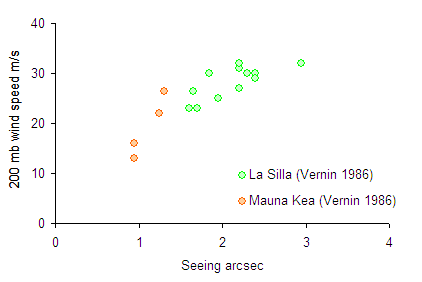
It is a well known among amateur (and professional?) astronomers that the jet stream is important for the seeing. Or is it? What evidence exists to support this important role of the jet stream? Vernin (1986) reported a good correlation between the wind speed at the 200 milibar level (the jet stream) and seeing at Mauna Kea and La Silla, and suggested that a jet stream speed of less than 20 meters/second was a requirement for good seeing. 


Later studies have however cast serious doubt on this; a large quantity of data from various observatories shows a poor correlation between seeing and jet stream speed. Good seeing can apparently be experienced even under a strong jet stream.  The seeing estimates below were made using the DIMM method.


Data from Vernin 1986: Astronomical Site Selection - A New Meteorological Approach, Bounhir et al. 2009: High-altitude wind velocity at Oukaimeden observatory, Tokovinin et al. 2003: Statistics of turbulence profile at Cerro Tololo, and Garcia-Lorenzo et al. 2009: Adaptive optics parameters connection to wind speed at the Teide observatory.


My own seeing estimates also show only a slight correlation (actually non-significant; P=0.06) relationship between the seeing (visually estimated, Pickering scale) and the speed of the jet stream. 


There does however seem to be a relation between the coherence time (the “speed” of the seeing) and the jet stream speed.


The above graphs, modified from Garcia-Lorenzo et al. 2009, indicate the necessary exposure time to “freeze” the seeing at a given wind speed at the 200 mbar level (top) and at ground level (bottom). The corresponding frame rate for a video capture is shown on the right Y-axis. The correlation is not high, but in general higher wind speeds, both at ground level and in the jet stream, correlate with shorter coherence time. To match the shorter coherence times at high wind speeds, frame rates above 200 frames/sec (fps) may be necessary. The popular Imaging Source cameras using the Sony ICX098BL chip can achieve only 30 fps without artefacts. Their new model with the Sony ICX618ALA chip can reach 60 fps. The Flea3 from Point Grey can reach 120 fps (possibly with artefacts), or more with ROI (Region Of Interest). The very short exposure times that come with such high frame rates can only be used on a very bright target (e.g. Venus, Mars, the Sun), or with a telescope setup with a low effective focal ratio. 


The wind throughout the whole column of air affects the seeing, as this profile of turbulence shows:


As we see the wind at ground level is more important than the jet stream (notice the logarithmic scale). 


Wednesday, June 15, 2011

Moons, spokes, and a storm

Here's a couple of old animations. First, Jupiter from November 2010, with Europa on the right and Io appearing out the the shadow on the left. The animation was done by fellow Cloudynights member MvZ, and was featured in Wired. It is one of the best (series of) images I have achieved with my trusty old Toucam Pro web camera. 

 
Click for original size


Next is Saturn, captured with my new DBK21 camera in Mar 2011. The great storm of 2011 is visible in the northern hemisphere. At the left side spokes are visible as dark patches on the rings. For some reason spokes seem to occur most often on the "morning" side of the rings, that is, where the rings rotate out of the shadow from the planet. The new camera does make it easier to get quality images, but still the quality of the seeing is a critical factor; if the seeing is bad both cameras will give bad results.